1 · Shoulder
Chuck
Chuck roasts, flat iron steaks, and stew meat are common examples. Some chuck may be used for ground beef.
 PARSONS RANCHCATTLE · CARE · COUNTRY
Know your animal share
A large, simple guide to where familiar steaks, roasts, and other cuts come from.
This guide is here when you want a closer look. The diagram stays tucked away until you choose to see it.
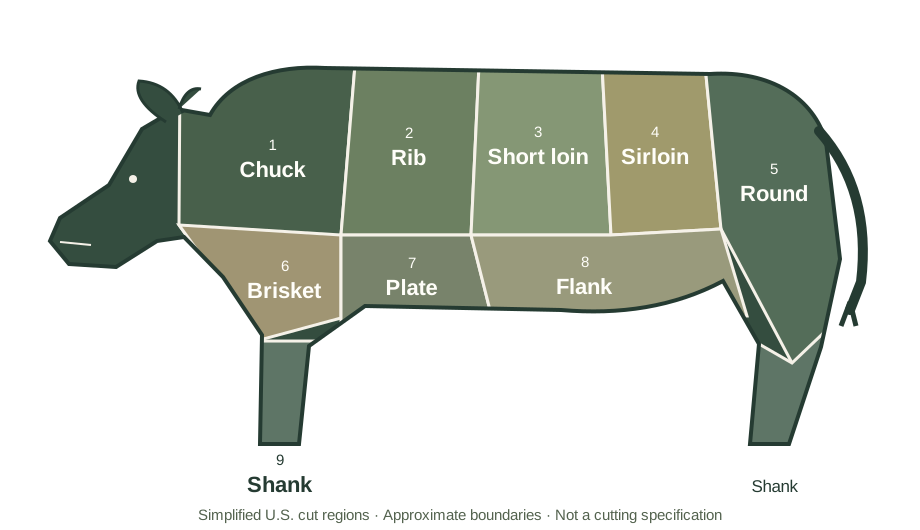
Choose a labeled region to read about its common cuts. On a phone, swipe across the diagram or open the large version and zoom.
The short loin and sirloin are shown separately for clarity; both belong to the loin region. Tenderloin runs inside the loin and is not shown as a separate surface region.
1 · Shoulder
Chuck roasts, flat iron steaks, and stew meat are common examples. Some chuck may be used for ground beef.
2 · Upper middle back
Ribeye steaks or a rib roast come from this area. A butcher may offer bone-in or boneless choices.
3 · Back, behind the rib
Strip steaks, T-bones, and porterhouse steaks come from this area. Bone-in steaks and separate tenderloin cuts are alternative cutting choices.
4 · Back, toward the hip
Top sirloin steaks and tri-tip are familiar examples. The sirloin is part of the loin region.
5 · Hind leg and rump
Round roasts, eye of round, and round steaks come from this area. Some portions can be used for ground beef.
6 · Lower chest
Brisket is often prepared slowly. Confirm whether the butcher will keep it whole or divide it into portions.
7 · Below the rib
Short ribs and skirt steak can come from this region. Cutting choices determine what is retained as individual cuts.
8 · Lower rear belly
Flank steak comes from this area. It is a different cut from skirt steak.
9 · Lower legs
Cross-cut shank includes meat and bone and is commonly suited to slow cooking. Shank can also be used for grinding.
Original Parsons Ranch schematic, informed by standard U.S. cut terminology and university extension guidance. Labels and boundaries are educational; butcher terminology and cutting options vary.